How this works
Enter your postcode and we look up which council serves your address, then fetch your collection schedule directly from that council’s own published data, the same information you’d find on their website, without the hunt. Some councils only need a postcode; others ask for a street address or property reference to narrow down your exact collection zone.
The checker covers hundreds of councils across Australia and the United Kingdom. If your council isn’t supported yet, our bin day guides cover bin colours, schedules and how to check with your council directly.
What bin day is it this week?
There is no national bin day. Collection day is set by your local council, and within a single council it changes street by street, because the area is carved into zones so the trucks can cover it across the working week. That is why a question as simple as “what bin day is it?” has no general answer, and why a neighbour one suburb over is an unreliable source.
What makes it harder is that most households are not on a single weekly cycle. A typical arrangement is general waste every week and recycling every second week, sometimes with garden or food organics on a third cycle of its own. So even once you know your day, you still have to track which week you are in. The checker above answers both at once: it returns the next collection date for every bin your council empties at your address, so you can see whether this is a recycling week without counting fortnights.
How to find your bin day
Three ways, in rough order of how quickly they work:
- Check by postcode. Use the checker at the top of this page. It matches your postcode to a council, asks for a street address only if that council needs one to identify your zone, and reads the schedule the council publishes.
- Your council’s website. Every council publishes a schedule somewhere, though it is often a zone map plus a PDF calendar you have to cross-reference yourself. Our council bin day guides link straight to the right page for each one.
- Your rates or council tax paperwork. Slower, but it is often printed there, and it is worth checking if you have just moved and are not sure which council you are even in.
Whichever route you take, the answer is only good until the next public holiday. Holiday weeks are where most missed collections happen, because councils handle them differently: some collect as normal, some shift the whole week back a day, some run a weekend catch-up.
Bin colours are not the same everywhere
If you have moved recently, the colour you learned at your old address is now working against you. Most Australian councils follow the Australian Standard AS 4123.7: red lid for general waste, yellow for mixed recycling, green for garden or food organics. But it is a convention, not a rule, and plenty of councils depart from it. The UK has no national standard at all, so a black bin can be general waste in one council and recycling in the next one along.
The checker shows the colours your own council actually uses, and our bin day guides break down the full colour scheme council by council.
Bin day questions, answered
How do I find out when my bin day is?
Enter your postcode in the checker on this page. We work out which council serves your address and fetch your collection schedule from the council’s own published data. Some councils only need a postcode; others ask for a street address or property reference to pin down your collection zone.
What bin day is it today?
There is no single answer, because bin day is set by your council and differs street by street. The checker above returns your next collection date and tells you which bins are due on it, which is the fastest way to find out whether today or tomorrow is your day.
Which bins go out this week in my area?
The checker shows every bin your council collects at your address, with the next collection date for each, so you can see at a glance whether it’s a recycling week or a general waste week. Most councils alternate recycling and general waste on a fortnightly cycle.
Is there a bin collection calendar I can check?
Most councils publish a calendar, but you usually have to find your zone first and then read it off a PDF or a map. The checker above skips that step: it reads the same published schedule and gives you the dates for your address directly.
What happens to bin day on a public holiday?
It depends on the council. Some collect as normal, some push every collection back a day for the rest of the week, and some run a catch-up on the weekend. Because the checker reads your council’s live schedule rather than assuming a fixed weekly pattern, holiday changes show up in your next collection date where the council has published them.
Why do neighbouring streets have different bin days?
Councils split their area into collection zones to balance truck routes across the week. Two streets next to each other can sit in different zones, which is why asking a neighbour, or even checking a friend’s schedule one suburb over, can give you the wrong day.
What do the bin lid colours mean?
In Australia most councils follow AS 4123.7: a red lid for general waste, yellow for mixed recycling and green for garden or food organics. The UK has no national standard, so a black bin can mean general waste in one council and recycling in the next. The checker shows the colours your own council uses.
What if I missed my bin collection?
Most councils will not return for a missed bin and will ask you to wait for the next scheduled collection, though many accept a missed collection report online within a day or two if the truck skipped your street. Check your council’s website for their policy.
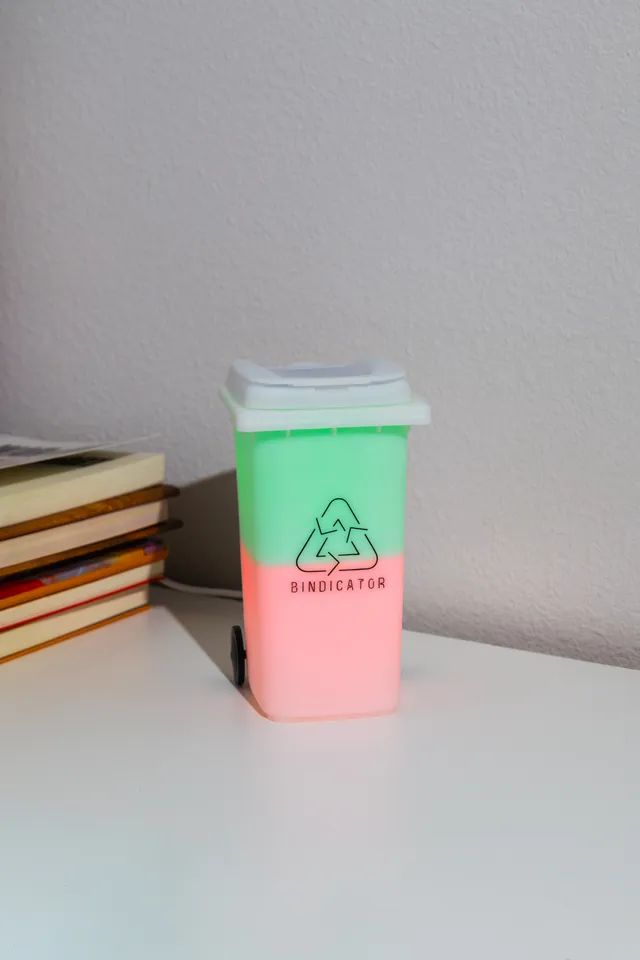
Check once, then never again
Knowing your bin day is one thing. Remembering it every single week, including which fortnight the recycling goes out, and what happens after a public holiday, is the part everyone gets wrong. That’s the part Bindicator fixes: a small lamp that glows in your council’s bin colours the night before collection. No app to check, no calendar to count. It costs A$35 once, with no subscription.